
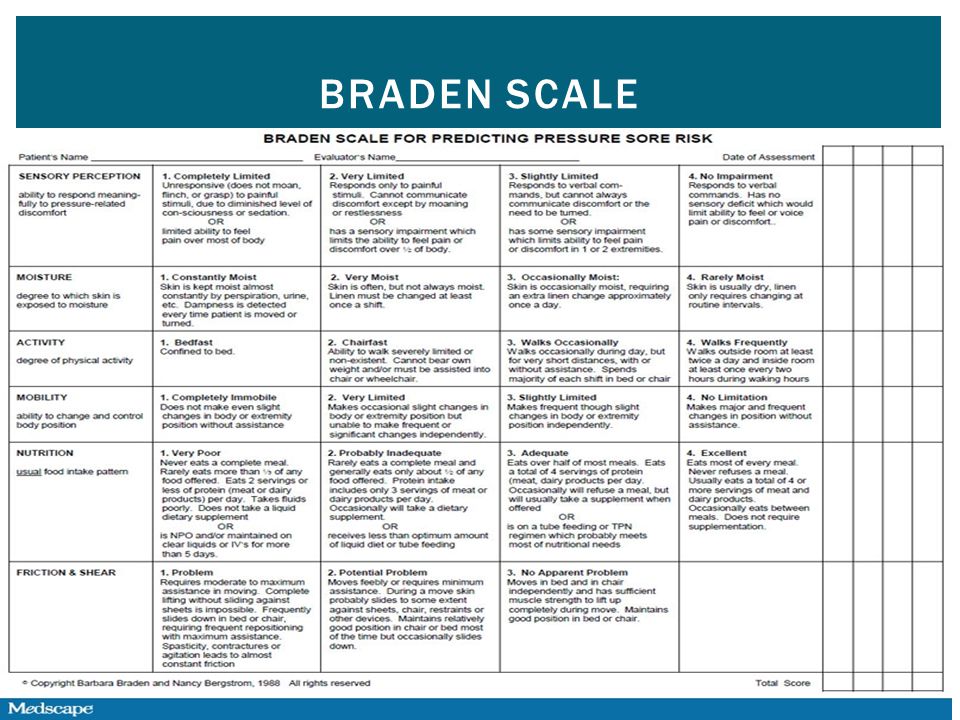
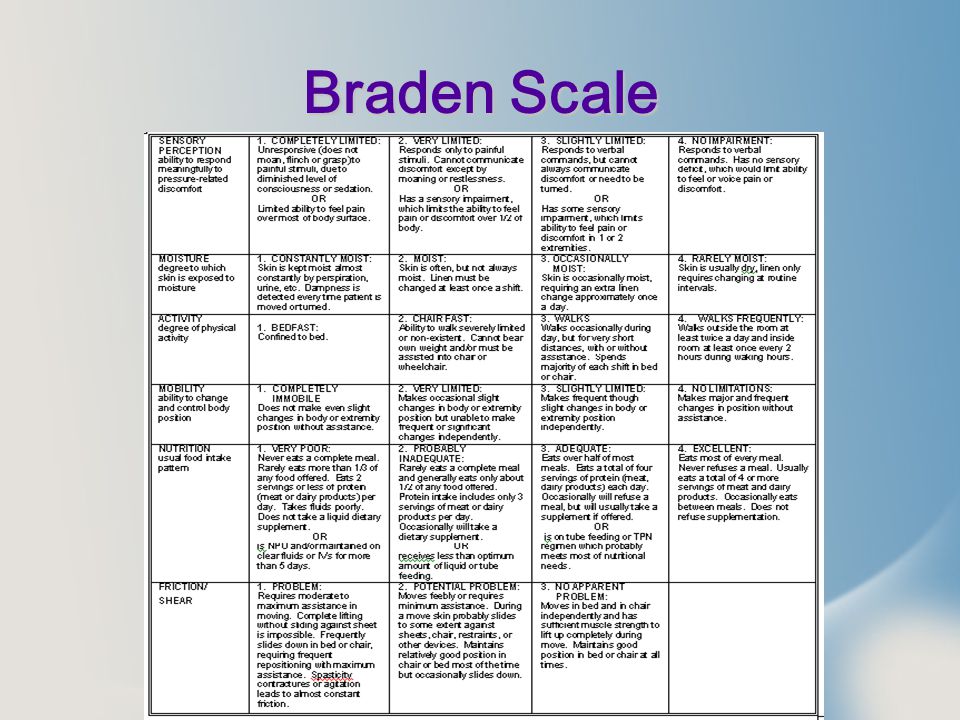
A bit about the braden scale. The braden scale has proven to be highly effective in assessing the risks for hospital acquired pressure ulcers (hapu) among patients in medical, surgical, and critical care settings. If any of the six subscales have a score of 1, 2 or 3, it may indicate a higher risk for skin breakdown. To view the breden scale for. Unresponsive (does not moan, flinch, or grasp) to painful stimuli, due to diminished level of consciousness or sedation.
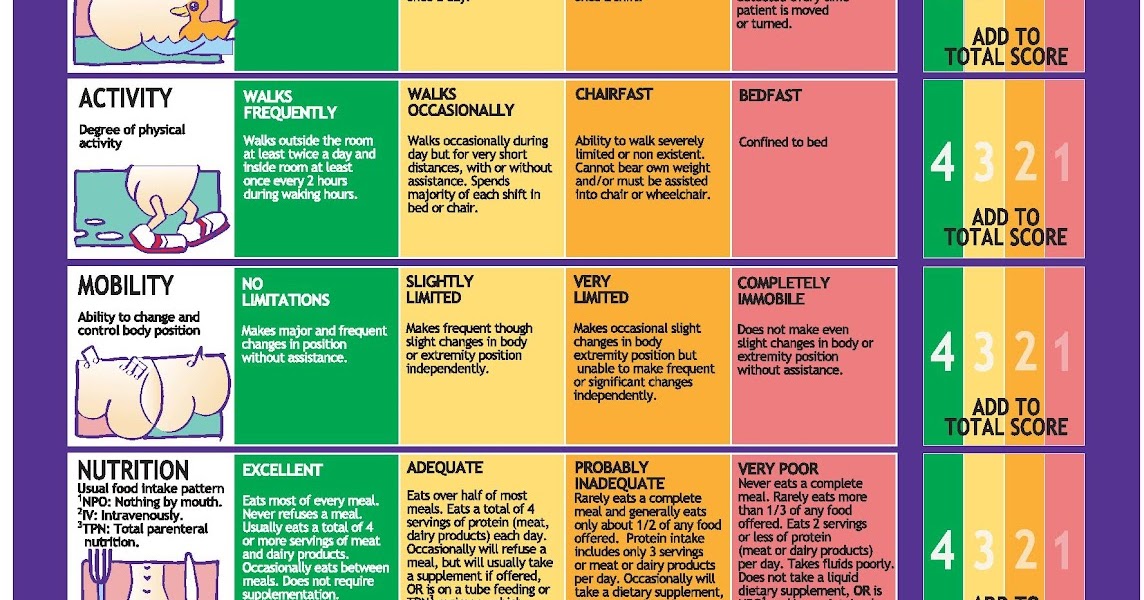
See figure 10.21 [1] for an image of a braden scale. Each item is scored between 1 and 4 guided by a descriptor. Skin is kept moist almost constantly by perspiration, urine, etc. The braden scale was developed by barbara braden and nancy bergstrom in 1988 and has since been used widely in. Six elements that contribute to either higher intensity and duration of pressure or lower tissue tolerance to pressure therefore increasing the risk of pressure ulcer development.
Individuals with a score of 18 or less are considered to be at risk of developing pressure ulcers. Braden scale for predicting pressure ulcer risk. Total score 9 high risk: A bit about the braden scale. Barbara braden and nancy bergstrom.
Braden Scale Eating Pain

Predicting Pressure Injury Risk in Pediatric Patients The Braden QD

Printable Braden Scale

Printable Braden Scale

Printable Braden Scale Sapjeiheart vrogue.co
Printable Braden Scale Printable Blank World
Printable Braden Scale Customize and Print

braden_q_scale.pdf Pain Perception

Braden Score Chart Labb by AG
Braden Scale Pdf Fill Online, Printable, Fillable, Blank pdfFiller

The first of the braden risk assessment scales is the braden scale for predicting pressure sore risk. Braden scale for predicting pressure sore risk. The evaluation is based on six indicators: Braden scale for predicting pressure ulcer risk. Risk factors are rated on a scale from 1 to 4, with 1 being “completely limited” and 4 being “no impairment.”. Braden scale for predicting pressure sore risk. The braden scale for predicting pressure ulcer risk, is a tool that was developed in 1987 by barbara braden and nancy bergstrom. Unresponsive (does not moan, flinch, or grasp) to painful stimuli, due to diminished level of consciousness or sedation. The coloplast logo is a registered trademark of coloplast a/s. Ability to respond meaningfully to pressure related discomfort. Barbara braden and nancy bergstrom. Or limited ability to feel pa in over most of body. Barbara braden and nancy bergstrom. If any of the six subscales have a score of 1, 2 or 3, it may indicate a higher risk for skin breakdown. Sensory perception, moisture, activity, mobility, nutrition, and friction or shear.
Barbara Braden And Nancy Bergstrom.
Easily fill and download the braden scale chart for free in pdf and word formats. Barbara braden and nancy bergstrom. Six elements that contribute to either higher intensity and duration of pressure or lower tissue tolerance to pressure therefore increasing the risk of pressure ulcer development. The scale consists of six subscales that reflect determinants of pressure (sensory perception, activity and mobility) and factors influencing tissue tolerance (moisture, nutrition and friction and shear).
Dampness Is Detected Every Time Patient Is Moved Or Turned.
Protocol for braden moisture subscale. Ability to respond meaningfully to pressure related discomfort. Proceed by completing applicable information for each numbered site on chart to include ostomies. See figure 10.21 [1] for an image of a braden scale.
Total Score 9 High Risk:
The first of the braden risk assessment scales is the braden scale for predicting pressure sore risk. A bit about the braden scale. Risk factors are rated on a scale from 1 to 4, with 1 being “completely limited” and 4 being “no impairment.”. Total score 9 high risk:
The Braden Scale Is A Scale That Measures The Risk Of Developing Pressure Ulcers.
To view the breden scale for. The braden scale for predicting pressure sore risk. Braden scale for predicting pressure sore risk. Use the braden scale to assess the patient’s level of risk for development of pressure ulcers.